New to Sports Cards? Start Here ↓
Here's something nobody tells you at the counter: every single person who loves this hobby started out completely lost in it.
Walk into a card shop and you'll hear refractor, parallel, case hit, slab, pop one. Nobody stops to explain any of it. You either already know, or you stand there nodding like you do.
I nodded for a long time.
That's a lousy way to welcome somebody into something this fun. So here's the whole thing in plain English, no gatekeeping, no quiz at the end. Read it once and you'll understand about 90% of what you see on our site, on eBay, or in any shop in the country.
Let's go.
First: a card is just cardboard until people agree it isn't
Every card starts the same way. A picture of a player printed on card stock.
What makes one card worth $2 and another worth $2,000 comes down to four things:
- Who is on it
- How rare it is
- What condition it's in
- How many people want it right now
That's it. Everything below is just detail on those four things.
The card stock: paper vs chrome
This is the first fork in the road, and it's easy.
Paper. Traditional cardboard. Matte finish. This is what your dad's cards looked like. Paper is the foundation of the hobby and plenty of the most famous cards ever made are paper.
Chrome. Printed on a shiny metallic stock. Brighter colors, glossier, and it holds up better over time. Chrome is where most of the modern money is, because chrome is what gets turned into the colorful versions we'll talk about in a second.
Same player, same year, same photo. The chrome version is usually worth more.
The five things that make a card "special"
When someone says they pulled something good, it's almost always one of these five.
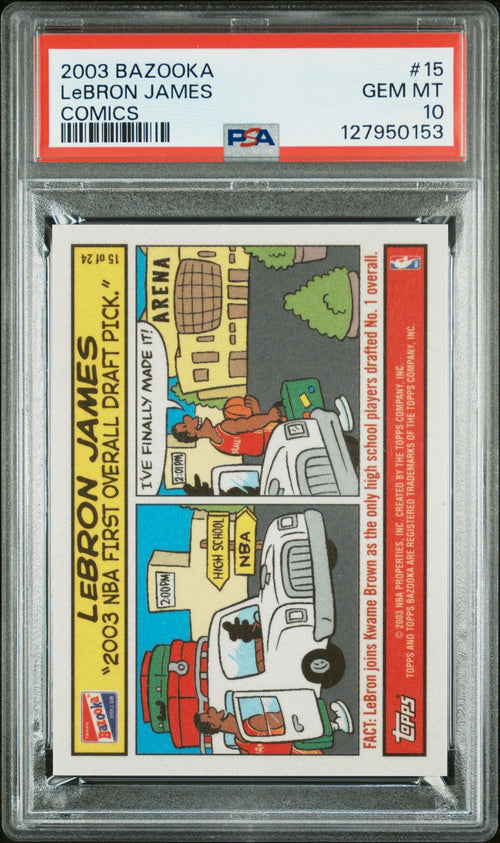
1. Insert. A bonus card added to a set with its own separate design. Not part of the numbered base set. Think of it as a special edition inside the regular edition.
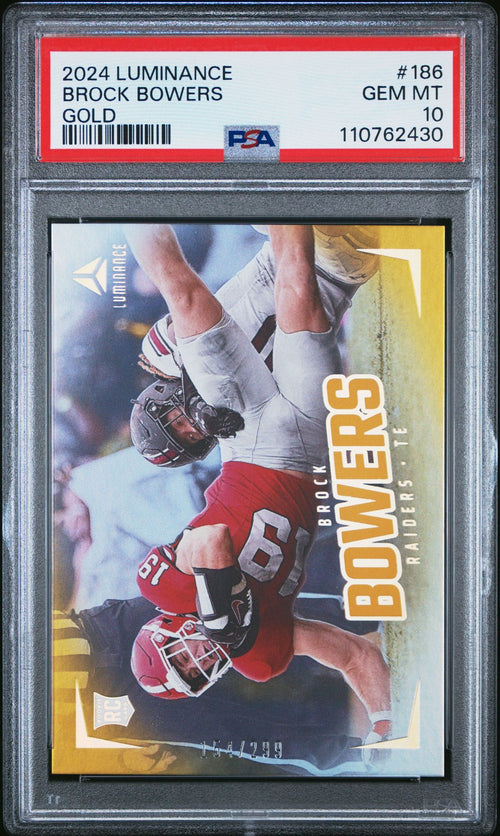
2. Numbered. The card literally has a number stamped on it, like 25/99. That means this is copy 25 out of only 99 ever printed. Lower total number means fewer exist. Fewer exist usually means more money.
Where's the serial? Depends on the card. Some print it on the front, some on the back, some sideways along an edge in tiny foil type. If you can't find it, flip the card over and check near the card number before you assume it isn't numbered.
3. Case Hit. A card so rare it shows up roughly once per sealed case of product, not once per box. Shops open cases. This is the card they're hoping for.
4. Autograph. Signed by the player. The gold standard is an on-card auto, where the athlete signed the actual card. The lesser version is a sticker auto, where they signed a clear sticker that got applied at the factory. On-card is worth more. Always.
5. Relic. A piece of real material embedded in the card. Game-worn jersey swatch, a piece of a bat, sometimes a patch with multiple colors. A plain one-color swatch is common. A multi-color patch from a logo or number is not.
One more you'll run into: die-cut. That's a card physically cut into a shape instead of a plain rectangle. Sometimes a trophy silhouette, sometimes an angled frame. It's a design choice, not a rarity level on its own, but die-cuts are usually limited and they're fragile. Sharp cut edges damage easily, which is part of why a high grade on a die-cut is harder to get.
A single card can be several of these at once. A rookie autograph patch numbered to 99 is four of them stacked. That's why those cards cost what they cost.
Parallels: the color thing
This is the one that trips up the most people, so read it twice and don't feel bad about it. Once parallels click, most of the rest of the hobby gets a whole lot easier.
A parallel is the exact same card, same photo, same card number, printed with a different color or pattern. The company prints fewer of each color as the colors get better.
A typical ladder looks something like this:
- Base — unlimited, the standard version
- Refractor / Silver — shinier, more limited
- Colored parallels — numbered to 199, then 99, then 75, then 25, then 10
- 1-of-1 — literally one copy exists on earth
Same player. Same photo. Wildly different value.
This is the most important thing in this entire guide: when you're checking what a card is worth, you have to compare the exact same parallel. A base version and a gold version numbered to 10 are not the same card, even though they look almost identical in a phone photo.
Rookie cards, and why year one matters
A rookie card is a player's first officially licensed card. Collectors care about them more than any other year, and they'll pay a premium for it.
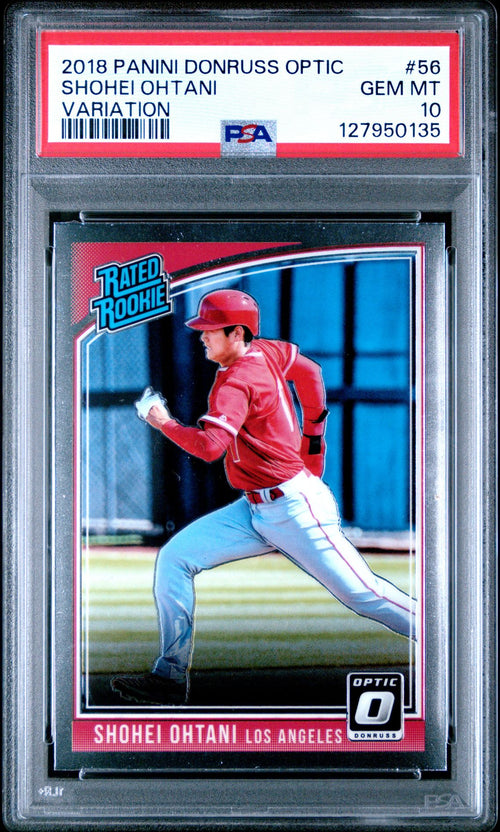
Look for the letters RC on the card, or "Rated Rookie," "Year One," or similar language depending on the brand.
Fair warning: a player can have thirty different rookie cards across different sets in the same year. They are not all worth the same. Set and parallel still decide the price.
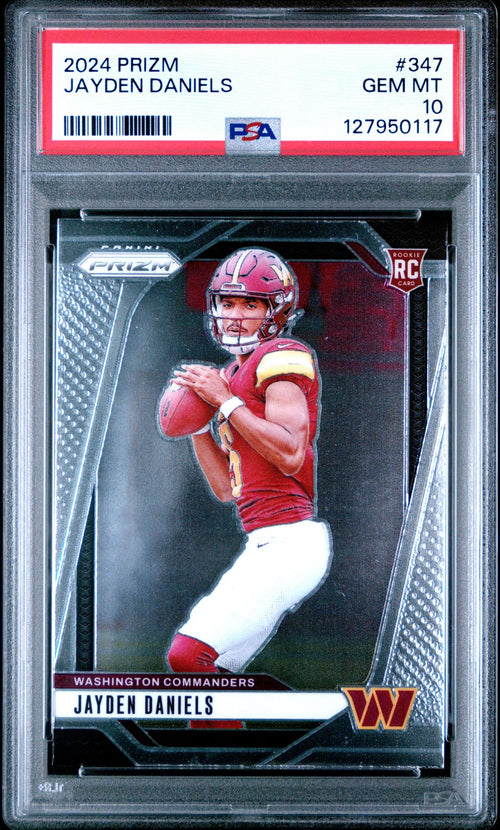
If you want to see what graded rookies actually look like in the wild, our graded NFL cards are a decent place to browse. Every one shows the grade and the cert number right on the listing.
Grading: what that plastic case actually means
You'll see cards sealed in hard plastic with a label on top. That's a slab, and it means the card was professionally graded.
Here's how it works. You mail your card to a grading company. The two big ones are PSA and SGC. They examine it under magnification and score four things:
- Centering — is the picture straight on the cardboard
- Corners — sharp or soft
- Edges — clean or chipped
- Surface — scratches, print dots, gloss
They give it a number from 1 to 10. A 10 is called Gem Mint. A 9 is Mint. An 8 is Near Mint-Mint. Then they seal it in the case with a label showing the grade and a cert number.
Two things that matter more than people realize:
The jump from 9 to 10 is not small. The same card can be worth $80 in a PSA 9 and $400 in a PSA 10. Same card. One point apart. That gap is the entire reason grading exists as a business.
The cert number is your receipt. You can type it into PSA's website and confirm the card, the grade, and that the slab is real. If you ever buy a graded card and the seller won't show you the cert number clearly, walk away.
You'll also hear POP, short for population. That's how many copies of that card exist at that grade. A "POP 1" PSA 10 means it's the only one graded that high. That's genuinely rare, and it's priced like it.
Where cards come from: packs and boxes
Cards get sold sealed, and there are a few tiers. Quick honest breakdown.
- Blaster — the small box at Target or Walmart. Cheapest entry point. Fun to open. Long odds on anything valuable.
- Mega — a bigger retail box, sometimes with exclusive parallels you can't get anywhere else.
- Hobby — sold through card shops, not big box stores. Better odds. Most products guarantee at least one autograph or relic per box.
- Jumbo — the biggest packs, most hits per box, highest price.
All four are fun. None of them are an investment strategy.
The part nobody tells beginners
Opening packs is gambling. Buying a specific card is shopping.
Both are fine. They're just completely different activities and you should know which one you're doing.
And this is not a knock on ripping packs. Some of the best ten seconds in this entire hobby happen right before you flip a card over. If you want to sit on the floor with your kid on a Sunday and tear into a blaster, do it. That's a fantastic use of thirty bucks and nobody should talk you out of it.
But if what you actually want is the Patrick Mahomes rookie card — go buy the Patrick Mahomes rookie card. You'll know exactly what you're getting, exactly what condition it's in, and exactly what you paid. Most people who chase one specific card through packs end up spending three or four times what that card costs on the open market.
We'd rather tell you that now than have you find it out the expensive way.
How to know what a card is actually worth
Ignore the asking price. Anybody can ask anything.
Look at sold prices. On eBay, search the card, then filter to Sold Items. That's what real people actually paid in the last 90 days. That number is the truth.
Two rules when you do it:
- Match the exact parallel and serial number range
- Match the exact grade, because a PSA 9 and a PSA 10 are two different markets
Serious collectors also use tools like Market Movers to track price trends over time. Not required to start. Worth knowing it exists.
Your first five steps
- Pick one thing. One player, one team, or one sport. A focused $200 collection beats a scattered $2,000 one.
- Learn to read a card. Year, brand, set, card number, parallel. It's all printed right there.
- Look up three sold comps before you buy anything.
- Buy one graded card. Even a modest one. Holding a slab and verifying the cert teaches you more than a month of reading.
- Protect what you keep. Penny sleeve first, then a top loader. Never a rubber band, never a shoebox, never tape.
And you're going to mess some of this up. Everybody does. You'll overpay for something, or buy the base version when you meant to buy the parallel, and it'll sting for about a day. Then you'll know something you didn't know before, which is genuinely the whole point.
Here's mine. Last summer I sold a 2018 Topps Shohei Ohtani rookie, PSA 10, for a hundred and eighty bucks. Felt fine about it. Card came in, card went out, money in the account, on to the next one.
That same card is closing around $800 at auction now.
I never pulled the comps. I had a number in my head that felt about right and I went with it. And here's the part that really gets me: when I sat down to write this, I misremembered the whole thing. Wrong set, wrong price, wrong everything. Had to go dig up my own eBay receipts to get it straight.
That's the mistake, and it's exactly why step three up there exists. Two minutes of looking would have been the best-paid two minutes of my life.
That's the whole hobby
Card stock. Rarity. Condition. Demand.
Everything else is vocabulary sitting on top of those four ideas, and now you know the vocabulary.
We built JerseyDon because this stuff should be understandable, accessible, and affordable, and because there's no good reason a hobby this fun should make anybody feel small for asking a question. Every graded card on our site lists its grade and its cert number so you can check our work before you spend a dollar.
So ask us things. Which card, which grade, whether the one you're staring at on eBay is a fair price. We'll give you a straight answer every time, even when the straight answer is "don't buy that one."
Welcome to the hobby. You're going to like it here.
Thank you,
Patrick
JerseyDon